
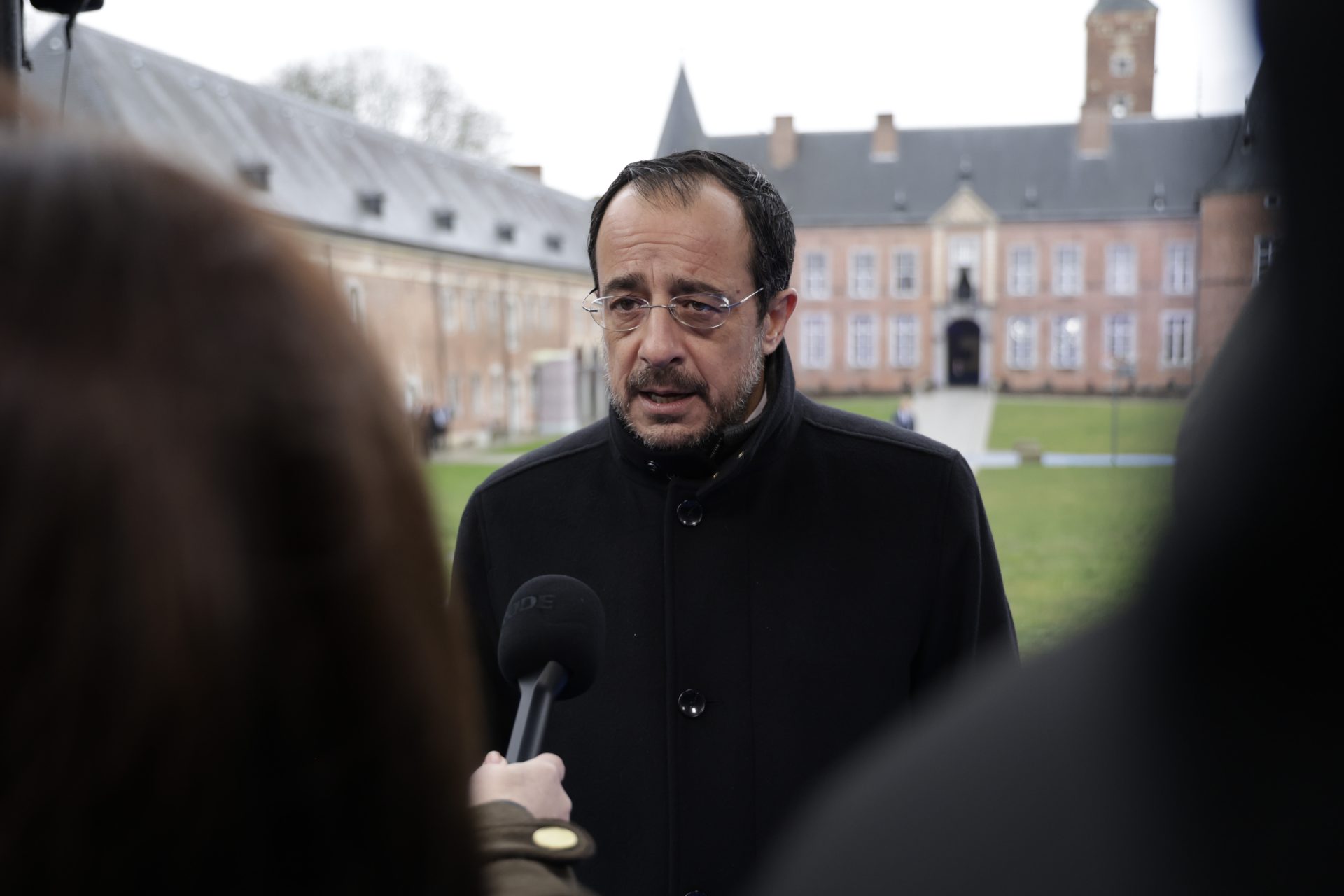
President Nikos Christodoulides has said that strengthening the European Union’s competitiveness must become a central priority for the bloc, as he arrived at an informal European Council focused on economic performance.
Speaking to reporters at the Alden Biesen Castle venue, Christodoulides described the meeting as one of the most important informal summits convened in recent years, noting it followed a joint letter signed by 22 member states — including Cyprus — calling for action on competitiveness.
He said Cyprus is presenting eight specific proposals aimed at boosting the EU’s economic strength, adding that competitiveness is also a core priority of Cyprus’s upcoming EU Council presidency.
“We cannot speak about strategic autonomy without being strong on competitiveness,” he said.
Christodoulides drew parallels with last year’s informal summit on defence and security, which he said produced “tangible progress” after years of limited results.
He expressed hope that the meeting would similarly lead to decisions with clear timelines.
The president said he would also meet Greek Prime Minister Kyriakos Mitsotakis for a briefing on the latter’s talks with Turkish President Recep Tayyip Erdoğan in Ankara. In addition, he planned discussions with Mediterranean EU leaders ahead of next week’s meeting in Washington hosted by the U.S. president, particularly on issues related to Gaza.
Asked which element of competitiveness he considers most crucial, Christodoulides pointed to the need to complete the EU’s Single Market, calling it a major asset for the bloc’s 450 million citizens. He also highlighted the importance of free‑trade agreements, deregulation and reducing unnecessary administrative burdens.
He noted that Cyprus has engaged with European business groups such as BusinessEurope and Eurochambres, as well as domestic organisations including the Cyprus Chamber of Commerce and Industry and the Employers and Industrialists Federation.
Christodoulides said competitiveness should feature at every European Council meeting through 2026 to monitor progress and identify obstacles. He also welcomed the approval of €1.2 billion for Cyprus under the EU’s SAFE defence‑industry support instrument.
On the debate over potential EU‑level joint borrowing, he said no option should be excluded from discussions. “Everything must be on the table,” he said, adding that the EU should identify areas where quick decisions can be made, including energy costs and Single Market reforms.
He also referred to a preparatory meeting earlier in the day involving a large number of EU leaders, convened by the German chancellor along with the prime ministers of Italy and Belgium, aimed at coordinating positions ahead of the summit.


