
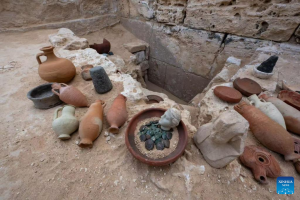
Nestled in the Kirsehir province of Türkiye’s Central Anatolia region, the Kaman-Kalehoyuk Archaeological Museum offers visitors a captivating journey through ancient civilizations.
Launched in 2010 with a grant from the Japanese government, the museum showcases artifacts unearthed since 1986 by a joint team of Japanese and Turkish archaeologists.
The museum’s collection spans from the early Bronze Age to the present, featuring artifacts from the Hittites, Phrygians, Romans, Byzantines, and Ottoman Empire.
Highlights include a piece of glasswork dating back to 1600 B.C., and a Hittite griffin illustration from around 2200-2300 B.C., partially destroyed by fire.
Chinese porcelain from the Ottoman Empire (1500s-1800s) reflects long-standing trade relations with the Far East. The museum encourages hands-on experiences, allowing visitors, especially children, to connect with artifacts crafted thousands of years ago.
In 2011, the museum was awarded the “Best Green Museum” title and was nominated for “Museum of the Year in Europe” in 2012. The complex also features the largest Japanese-style botanical garden outside Japan.
Türkiye has increased archaeological excavations in recent years, with the number of projects rising from 670 in 2021 to an expected 800 by 2026. These efforts aim to preserve Türkiye’s rich cultural heritage and uncover new historical treasures.