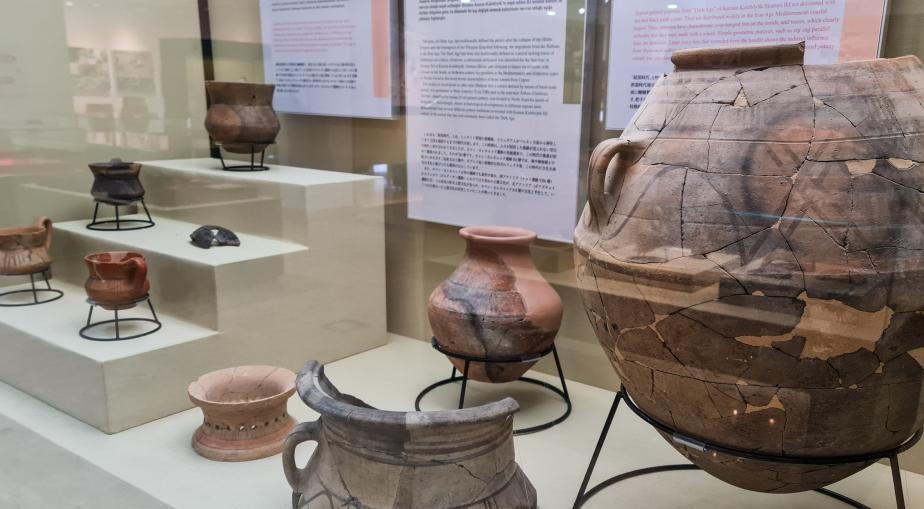
Nestled in Türkiye’s Central Anatolia region, the Kaman-Kalehoyuk Archaeological Museum offers visitors an immersive journey into ancient civilizations while showcasing ongoing excavations.
Since its 2010 launch, supported by a Japanese government grant, the museum has displayed artifacts unearthed by Japanese and Turkish archaeologists since 1986.
The collection spans from the early Bronze Age to the Ottoman Empire, highlighting civilizations such as the Hittites, Phrygians, Romans, and Byzantines.
A standout piece is a 1600 B.C. glass artifact, reflecting the region’s early glass production. Visitors can also marvel at a Hittite-era griffin illustration, tied to Akkadian culture, and Ottoman-era Chinese porcelain symbolizing historic trade with the Far East.
“We created this museum to ensure these priceless artifacts remain protected on-site and shared with the public,” said museum director Izzet Esen. The museum also encourages hands-on engagement, particularly for children, to foster a deeper connection with history.
In addition to winning the “Best Green Museum” title in 2011 and earning a nomination for “Museum of the Year in Europe” in 2012, the museum complex boasts a Japanese-style botanical garden—the largest of its kind outside Japan.
Türkiye’s archaeological efforts have grown substantially, with projects rising from 670 in 2021 to 765 in 2024. Experts, including Pamukkale University’s Celal Simsek, emphasize the importance of preserving and promoting cultural heritage to attract visitors and inspire younger generations.