
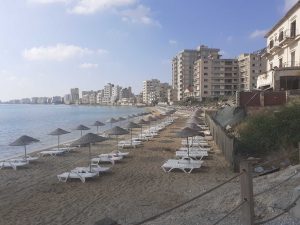
Hopes for the next step in the Cyprus problem now rest on President Nikos Christodoulides’ proposal for the simultaneous opening of the fenced-off area of Varosha under UN auspices and the reopening of Famagusta port under EU supervision.
But Ankara has the first and last word. At the leaders’ one-to-one meeting on Wednesday, Turkish Cypriot leader Tufan Erhurman did not close the door on the idea but appeared unable to make the crucial decision, which Greek Cypriot negotiator Menelaos Menelaou said would be to “get the discussion on track”.
Speaking to local television at midday, Menelaou said: “I can’t say more, because we are trying to get the discussion on track… how the aim will be served and the next substantive step taken.”
Signals from Ankara, however, are far from encouraging. Despite its declared effort to revive EU-Turkey relations and secure economic and geopolitical benefits, the government of Recep Tayyip Erdogan appears for now unwilling to take difficult decisions on Cyprus.
Instead, it gives the impression of playing for time until UN Secretary-General Antonio Guterres leaves office, in order to shed the framework he tabled at Crans-Montana, as Nicosia reads it.
Nicosia nevertheless still believes there is time to arrange another informal enlarged conference before Guterres steps down. It is investing both in more frequent contacts between Christodoulides and Erhurman, even if only low-level political meetings, as announced on Wednesday, and in the forthcoming return to the island of UN envoy Maria Angela Holguin.
As an alternative, it is now forced to adjust its plans for the post-Guterres era, with the main aim of safeguarding the negotiating acquis, as well as the effort to link the Cyprus problem with EU-Turkey relations, which, although it has yielded little so far, has been attempted.


