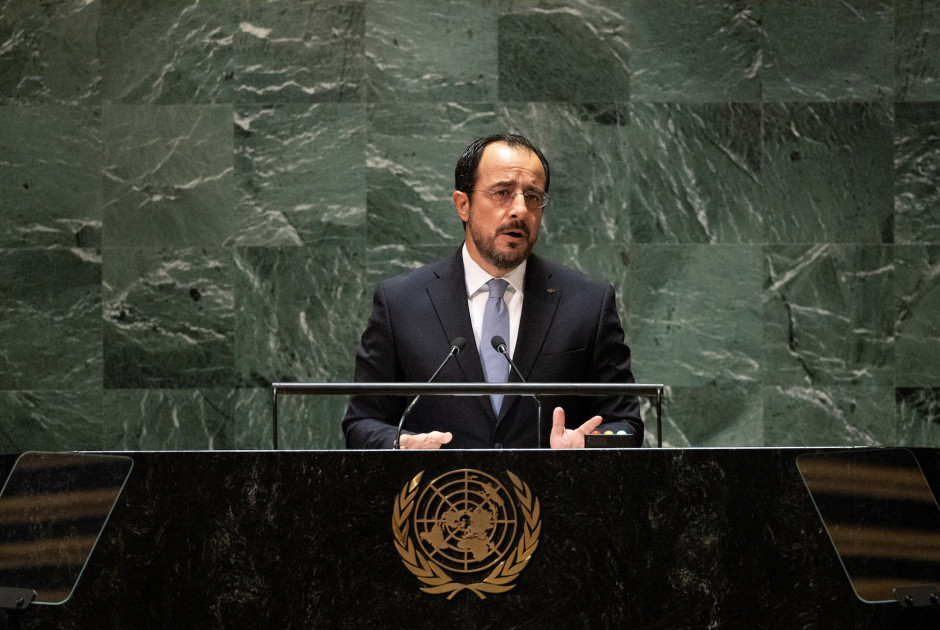
Nikos Christodoulides used his address to the UN General Assembly to link Cyprus’s 52-year division to a broader warning about the fraying of the postwar international order
The president of Cyprus, Nikos Christodoulides, opened his address to the 81st session of the UN General Assembly by invoking the hope that accompanied the founding of the United Nations 81 years ago — hope he said was now being tested as never before.
Referencing a remark made some years ago by the UN secretary-general, that the organisation was “the product of hope”, Christodoulides told delegates in New York that rapid advances in artificial intelligence, the reshaping of societies by climate change, and an increasingly contested and unpredictable international environment were placing unprecedented strain on the global order.
“The international order is not simply changing. It is being tested in unprecedented ways,” he said, arguing that in such uncertain times the foundational values of multilateralism – international law, the UN Charter, respect for sovereignty and territorial integrity, the peaceful settlement of disputes, human rights and the equality of states – needed active protection. These principles, he said, were not relics of the past but remained timeless and essential.
Small states and the UN Charter
Christodoulides framed much of his speech around the position of small and medium-sized states within the multilateral system. “Change is inevitable. What must remain constant is the UN Charter as our compass,” he said, noting that the Charter binds all states regardless of power, size or influence.
For smaller countries, he argued, the equality of states is a foundational principle underpinning collective trust – one that requires consistent application of international law, including the UN Convention on the Law of the Sea, and a commitment to peaceful dispute resolution. Cyprus, he said, was pursuing strategic autonomy while seeking partnerships and synergies with other states navigating a rapidly changing world.
“Large powers have weight. Smaller states must have persuasion. We cannot coerce. But we can unite forces. We cannot impose outcomes. But together, we can help shape them,” he told the assembly, adding that structural reform of the UN – including the UN80 initiative, the Pact for the Future and the 2030 Agenda – was only part of the answer; member states also needed genuine political will to protect the multilateral system.
He paid tribute to the outgoing decade of leadership by the secretary-general, António Guterres, praising his commitment to multilateralism during a period of unprecedented global upheaval.
Humanitarian role and Gaza
Christodoulides devoted a significant part of his speech to Cyprus’s humanitarian record, citing the country’s position at the crossroads of Europe, Asia and Africa. Following Hamas’s attack on Israel on 7 October 2023 and the ensuing humanitarian catastrophe in Gaza, he said Cyprus had directed more than 25% of its available budget to humanitarian aid for Palestinians and had established the Cyprus Maritime Humanitarian Corridor, developed in cooperation with the UN’s 2720 mechanism.
He said Cyprus had also repeatedly served as a “safe haven” for the evacuation of third-country nationals from the region, helping evacuate thousands of civilians from 70 countries over the past three years alone. Through the CyprusAid programme, he added, the country had also responded to natural disasters including the earthquake in Venezuela and flash floods in Nepal, as well as the humanitarian crisis in Sudan and the wider Sahel region.
Climate cooperation and the EU presidency
Turning to climate change, Christodoulides described rising temperatures, water scarcity and extreme weather as forces that respected neither borders nor politics, intensifying the volatile political dynamics of the eastern Mediterranean and Middle East. He pointed to Cyprus’s Regional Climate Change Initiative and the Cyprus Regional Aerial Firefighting hub, based at Paphos airbase with EU backing, as efforts to build collective resilience among regional partners. He also cited CYCLOPS, a training programme run jointly with the United States that has provided specialised instruction to thousands of officials from more than 50 countries across the Middle East, Africa, Central Asia and Europe over four years.
Reflecting on Cyprus’s presidency of the Council of the European Union in the first half of this year, Christodoulides noted that a country of fewer than one million people had taken responsibility for steering the agenda of a union of 450 million citizens. “Our size did not diminish the responsibility to lead. Nor did it diminish our capacity to respond to that responsibility,” he said, adding that isolation was “the opposite of responsibility, and a luxury we cannot afford”.
Cyprus problem and the credibility of the UN
Christodoulides closed by turning to the division of Cyprus, telling the assembly that the credibility of the UN depends on consistency in the application of international law – a principle he described not as abstract for Cyprus, but as “a painful, existential reality”.
Fifty-two years after what he called the illegal Turkish invasion of Cyprus, he said more than a third of the Republic’s territory remained under Turkish occupation, in continuing and flagrant violation of international law. Tens of thousands of displaced people and their descendants, he said, remain barred from returning to their homes, while Varosha remains sealed off, with Turkey defying explicit obligations set out in relevant UN Security Council resolutions.
He also cited violations of fundamental human rights, the destruction of religious and cultural heritage, and what he described as the organised transfer of settlers amounting to demographic alteration, as well as the enduring anguish of families still seeking answers about missing relatives.
“Respect for sovereignty and territorial integrity are not rhetorical formulas,” Christodoulides said. “Nor should they be applied selectively, depending on who the perpetrator is.”