
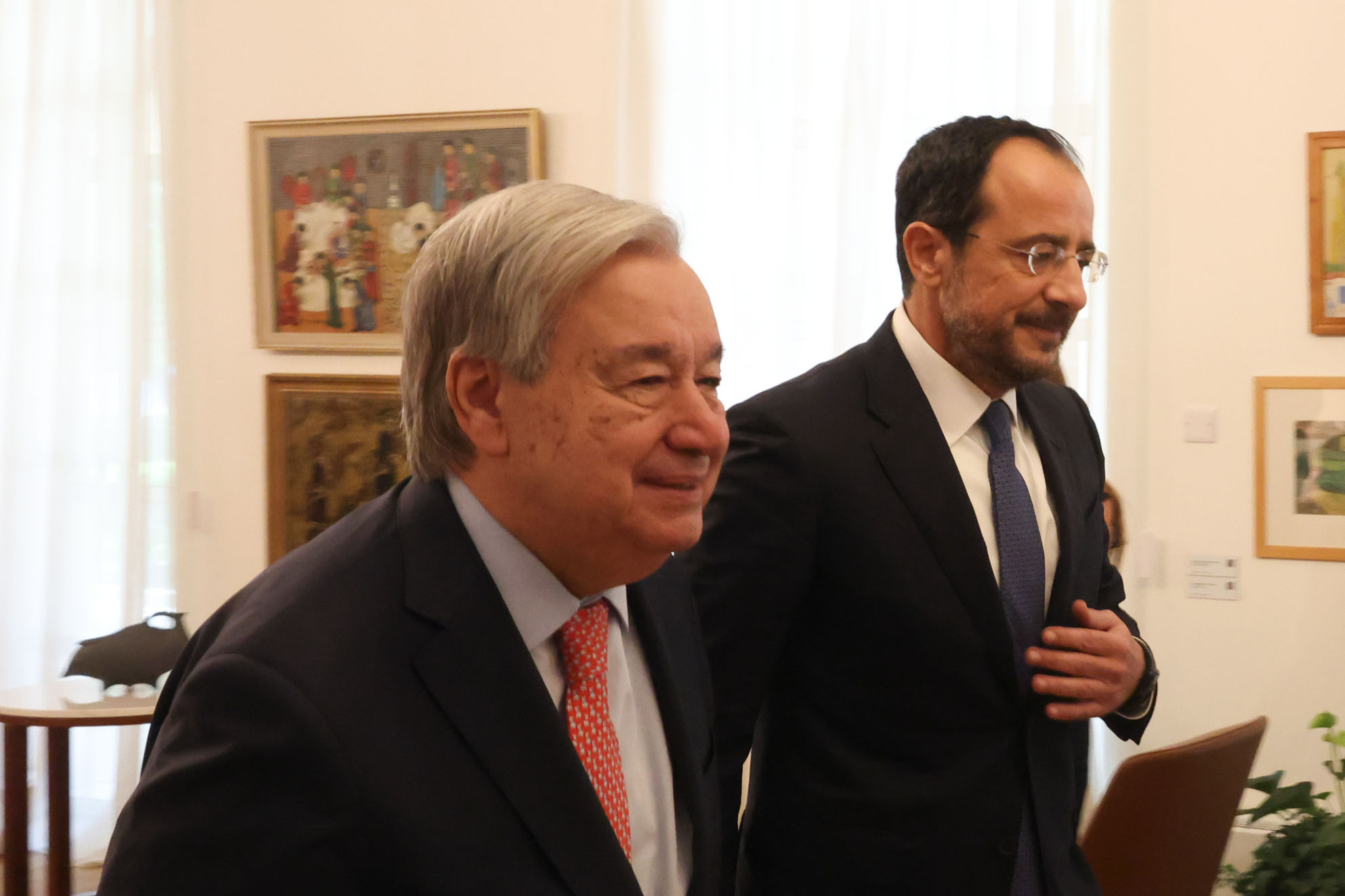
Cyprus’s government on Tuesday welcomed what it called the strong personal commitment of United Nations Secretary-General António Guterres to reviving stalled negotiations over the island’s decades-long division, after he met President Nikos Christodoulides at the Presidential Palace.
Speaking to reporters following the meeting, government spokesman Konstantinos Letymbiotis described the talks as substantive and candid. He said the government welcomed Mr Guterres’s sincere and strong personal political commitment to restarting negotiations in line with UN Security Council resolutions on the Cyprus problem, and reiterated Nicosia’s readiness to help translate that commitment into concrete developments — namely, a resumption of talks from the point at which they broke down.
The spokesman said Cyprus continued to support the efforts of the Secretary-General and his personal envoy, adding that the ultimate goal remained the convening of an informal, expanded conference that would serve as a springboard towards renewed negotiations. He expressed hope that all sides would demonstrate the same sincere political will that Mr Guterres had shown, both through the symbolism of his visit and through his own remarks.
Asked whether the Secretary-General had shared specific ideas for paving the way towards an informal five-party conference, Mr Letymbiotis said Mr Guterres, given his long involvement in the Cyprus issue and diplomatic contacts built up since initiatives he launched last March, clearly had thoughts on next steps. But he stressed that political will needed to be shown not only by Cypriots and the guarantor powers, but specifically by Turkey, which he said must align with international legality, UN Security Council resolutions, and the principle of a bizonal, bicommunal federation with political equality — as well as with EU law and the bloc’s four fundamental freedoms.

Asked what would happen once Mr Guterres’s term as Secretary-General ends, and whether groundwork was being laid for his successor, the spokesman said Cyprus hoped substantive progress — meaning a resumption of talks — would come before then. He noted that a working dinner between the Secretary-General, President Christodoulides and Tuncer Erhürman, the Turkish Cypriot leader, was due to take place that evening, with a joint meeting scheduled for the following day. He added that the real key to progress would be genuine intent from Turkey to realign with international legality.
On whether Mr Guterres had brought anything concrete to the meeting, the spokesman said the Secretary-General’s aim remained creating the conditions for an expanded conference focused on substantive discussion that would lead to a resumption of negotiations.
Asked about grounds for optimism, given that Mr Guterres spoke by phone with Turkey’s foreign minister on Sunday, the spokesman said the Secretary-General’s presence in Cyprus — his first visit to the island in that capacity, and the first such visit in 16 years — along with his personal involvement, was itself encouraging. He acknowledged, however, that Cyprus was fully aware of the challenges posed by what he described as Turkey’s intransigence in recent years, and said Nicosia would focus on remaining constructive and supporting President Christodoulides’s recent diplomatic efforts.
Reiterating the Greek Cypriot side’s negotiating position, the spokesman said Cyprus was seeking a bizonal, bicommunal federation with political equality, as set out in UN Security Council resolutions, preserving the acquis of previous negotiations, and guaranteeing a single sovereignty, single international personality and single citizenship. Any solution, he said, must be fully compatible with EU principles, values and law, with the Republic of Cyprus remaining a full member state and the bloc’s four fundamental freedoms upheld — parameters he described as non-negotiable, both in name and in substance.
Asked whether Mr Guterres had addressed preservation of the acquis from previous negotiations, the spokesman said this was easily understood to be common ground, but that talks had not yet reached that stage. He said all parties except Turkey agreed on the intended goal, while Turkey — which he referred to as the occupying power — continued to disregard international law and legality. Turkey, he said, must first return to the framework of international legality before substantive discussion could begin on resuming talks from where they left off.
The spokesman added that President Christodoulides had kept members of the National Council informed of developments, including his recent meeting with the UN Secretary-General’s personal envoy, María Ángela Holguín, and would continue to brief them as appropriate going forward.