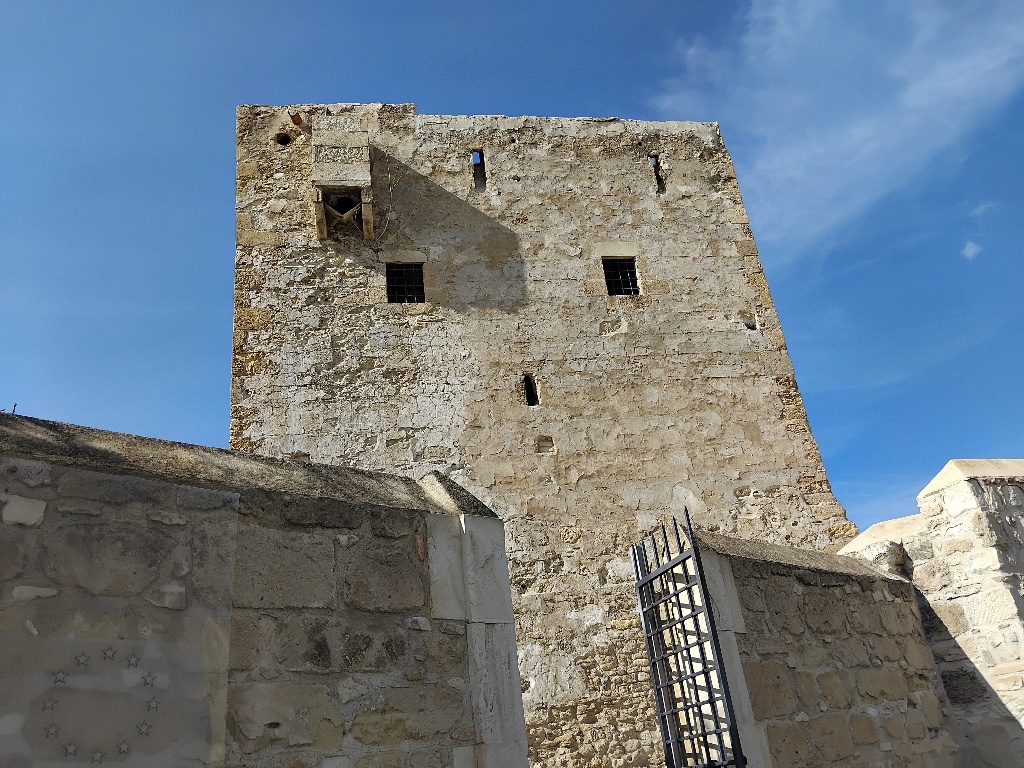
The medieval castle toilet, known as a “garderobe,” was a simple yet effective structure built into the castle’s walls.
The village of Pyla is developed in a strategic location, controlling the passage that leads from the north-east coasts of Cyprus to the central plain of the island.
The name Pyla originates from the Greek word “πύλη”, meaning the entrance or the passage, and is conceptually linked with its geographical location.
During the reign of the Lusignan’s (1191-1489), the “lordship of Pyles” was one of the major fiefs of the kingdom and was held by the Gibelet family.

It is impossible to obtain the precise date of the tower.
On stylistic grounds alone, it should be attributed to the 15th century and is better conceived as an observation tower, since it controls the passage from Larnaka to Mesaoria.
The tower stands at an elevation of about 126 metres above the sea level.
It is constructed of rubble masonry with ashlar blocks of white limestone in the corners. It is a small keep, rectangular in plan, and 7 metres tall.
It consists of three levels, a basement, a first storey entered via a square doorway on its west – presumably accessed by means of a wooden staircase and an upper storey with a flat roof.
The rooms have simple timber roofs.
The basement was used as a storage space, having no external openings, while the two storeys above had arrow slit openings, at the end of deep embrasures.
A machicolation on two corbels protected the first storey doorway, while another brattice at roof level on the opposite side of the tower appears to have served as a latrine, with its stone seat still in place.
This is the part of the wall that sticks out. It looks a little like a bay window. This was a toilet and the excrement would simply fall to the ground below. It remains unchanged – in the same condition for over 500 years!
In 2004, under the program of UNOPS (United Nations Office for Project Services), it was largely restored with funding from the European Union.